Loading...
Features
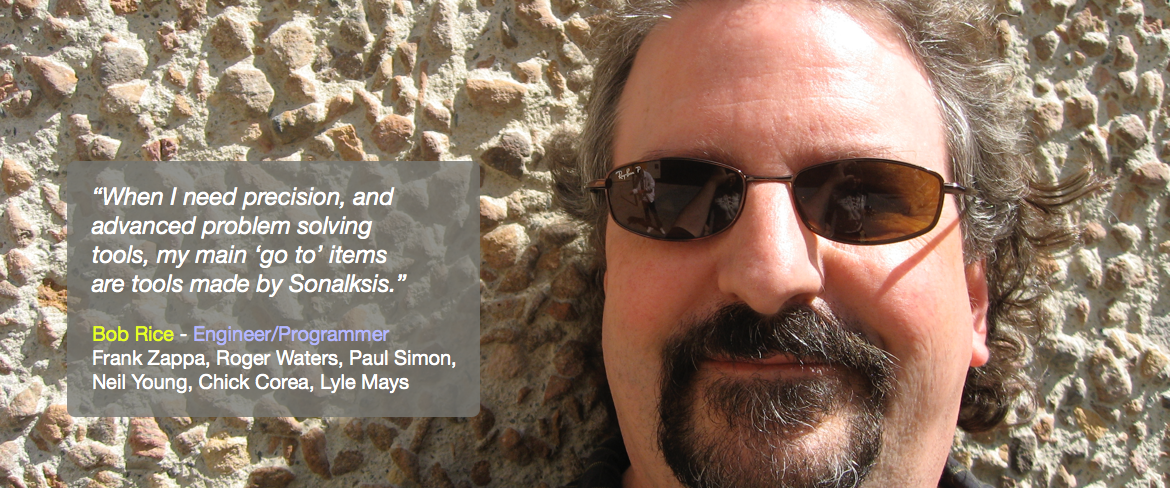
Sonalksis Meets Bob Rice For a Talk In Paris

Haven't you dreamt of being hired by your heroes in music? Bob Rice is one of those top-notch professionals who has worked with some of the most renowned artists in music, while keeping a humble and kind attitude. We met him in Paris during the Roger Waters 'Dark Side of the Moon' Tour, on which he was working as a multimedia engineer. We had a rewarding discussion about his career, and he gave us some advice and thoughts about computer music, surround sound, and the relationship between music and technology. From his first contacts with the Synclavier to the most advanced recording environments, from analogue tapes to digital plug-ins, he has had enough time to develop his skill and accumulate an impressive knowledge.
Like many sound engineers and producers, Bob was first trained as a musician. He began to play the piano and the guitar amongst other instruments when he was five, had a traditional musical education, and rapidly got interested in computer music. His entrance to university was an important step for him. They had just obtained a NED Synclavier II, and a teacher provided him access so he would go in at night to experiment he instrument.
"You had to learn some programming language that was specific to that system. It was called XML. And there was a graphical user interface that was unique to that machine, too. You could design waveforms based on additive synthesis, and there was a unique application of John Chowning's work on FM synthesis."
His first leap into the business started with a legend, Frank Zappa. When he got out of college, he hit the road with Frank Zappa to earn some money. Frank happened to have a Synclavier, and he was looking for somebody to work on it at his studio. That turned into a five-year stint working with Zappa resulting in Bob becoming a Synclavier specialist amongst other things.

"The first records I was primarily involved with were 'Franck Zappa meets the Mothers of Prevention' and 'Jazz from Hell'. And then I went on tour with them. I can hardly explain how much stuff I learned here. I mean, he knew everything there was to be known about writing music, making films, recording, editing... And he was so good at doing razor blade edits on analogue tapes that he continued to use the technique on digital tapes - which was really dangerous - before Sony was able to provide a digital editing system that was affordable."
Being in touch with such a personality had much influence on Bob. After his five years with Frank Zappa, he did some programming on the Synclavier for Chick Corea and toured with the Elektric Band. Today, his curriculum vitae contains some pretty big names like Stevie Wonder, Bonnie Raitt, George Michael, Lyle Mays, and Michael Jackson to name a few. Bob remains humble :
"I've been in a place where I've been able to work with amazing musicians, and at the same time some were remarkable recording engineers. So, I've been able to just absorb things that I've watched. You try to pay attention, and you learn when somebody is talking to you with the voice of experience."
Bob Rice has built up a solid reputation for his skill on digital editing and his knowledge of the most advanced digital environments. While having as many tools at his disposal as one could possibly dream of, he insists on the importance of preserving the integrity of the audio source.
"You want to draw focus to the melody, you don't want to draw the focus to the engineering. Most of the work that I've done in terms of digital audio, you'll never hear, and if you hear it, it's because that it's not good. If it's done well, you don't know it happened. So, it's kind of virtual, what I just absolutely hate about modern records is hearing Auto tune. Because I think it shows disrespect to people that can really sing in tune... And let things not be symmetrically balanced in the stereo field. If you have a mono source, don't tweak 22 ms with the delay, and pan hard left and hard right."
In connection with the problem of over processing, people are always in competition to get the maximum level. It can be a disaster for the original dynamics, not to mention the ears .
"I try not to limit too much. Musicians are trying to achieve dynamics that are part of the composition, and try to convey those dynamics to the listener on the CD end, and in live performance. And they have worked painstakingly to be able to play those dynamics in the context of that music. That makes the music breath. And the idea that you would plug it thru a box that destroys all the dynamics is just, I don't think it's a good thing to do! (laughs)"
Automation can be used in a clever way, not only to mix with the mouse instead of using a controller.
"Actually I use automation for effects, on compressors and EQs, so that I can pull them out when they're not needed. You know, there may be only a couple of points in a vocal track where you really want compression on a particular syllable. About mixing, I've kind of an old school approach. In a recent record I was riding the mix by hand, but writing all the moves into the Pro Tools session. I get the grand strokes from the controller and then go back to the computer to make them smoother with the mouse."

Yesterday the Synclavier was the ultimate workstation, and now you can do that at home with a laptop put on top of your laps!
"On the Synclavier there wasn't an interface like a mixing board, but you would call up an entire sequence, and all the samples would load. Everything would come back exactly the same as it has been saved, that was great for a composer like Frank Zappa who had, who knows, how many compositions going on at the same time. And we had stacks and stacks of floppy disks of music ! With a Dual Core Intel right now, you can have a pretty massive mix going on. And when you are at your home studio, you're not really constrained by the clock. You can spend your entire day tweaking your EQ if you wanted to."
"So, if you've really worked for hours to come up with an EQ and a particular characteristic sound that worked for your music with either synthesizer plug-ins, processing, or reverb, or whatever, all that stuff is saved in the library. Often application support for a folder of that plug-in. It is important to backup the system preferences of the user folder with your project. And people should be encouraged to backup their work very often, especially plug-in sets. It's very likely that the music you've written this week, you'll want to have it recovered in ten years. So it's an important thing to get a backup procedure too, in a home studio. Because medium and formats change so often. Even from DVD to Blue-Ray now. On a single disk you can pretty much save most of your project if you're doing 24 bits / 44,1 kHz. Almost an entire album project in one disk. Which is fantastic. It's literally unlimited..."
Let's go from disk space to acoustic spaces: Several artists such as Frank Zappa and Pink Floyd have experimented with the spatialization of sound in innovative ways that push forward the limits of technology. So when you have to manage a 45 degrees off axis Quad configuration for the Roger Waters Tour, none of the tools commonly used would be able to deal with that.
"I'm interested in how electronics can coexist with acoustic textures in terms of orchestration, probably because of what I learned from Lyle Mays. You don't just have acoustic music here and electronic music here. You can make electronic instruments sound organic, and there's a lot of great places to do that now with convolution reverbs, by putting an electronic instrument in a real place, instead of just being dry and direct. And you know, you can use reverb not just to be reverb, but to create space around the instruments. When I worked with Zappa, we often took sampled elements into a live space. So the samples contained the ambiance, and the ambience would also change from note to note, depending on how you would stretch the samples. So one note would be far away, one other would be close up, cause the reflection time would decrease when samples play faster. So there was a front to back motion even just in the context of one part."
"So, my point about surround is that's just the beginning. It's an interesting problem that there is no standardization of how people configure their surround systems yet. I don't know how tight that stuff is calibrated at all. In the studios, people are very precise when they build mastering environments, and mix in surround. And yet the delivery environment (i.e. somebody's home or movie theatre) is vastly different from one place to another, and you get a different rendering. So there are a lot of really interesting problems about mixing in surround."
Our sincere thanks go to Bob, for sharing his time and experience with us.
Content copyright © 2003-2010 Sonalksis Ltd